
Categorie popolari
State cercando un filato?



Commenti / Domande (40)
Amna Hassan ha scritto:
Is there a yarn over on both sides of the middle stitch throughout the shawl? In the pattern at some places it is not written. Here it is not written " AT THE SAME TIME dec 44 sts evenly on each side of mid st (dec by working approx. every 3rd and 4th st tog, do not dec over edge and mid st) = 269 sts on needle (there are 134 sts on each side of mid st). P 1 row from WS. Piece measures approx. 39 cm measured along mid st" And also at the second last row in diagram A.5 and A.6. Thank you
15.12.2015 - 04:32DROPS Design ha risposto:
Dear Mrs Hassan, on this row worked with dec, you don't inc on either side of mid sts, you only dec 88 sts (44 sts on each side of mid st. There were 357 sts - 88 sts = 269 sts remain. P next row from WS and continue with next diagrams, inc on each side of mid st are included in diagrams A.5 and A.6. Happy knitting!
15.12.2015 - 08:53Magda ha scritto:
Thank You!
03.07.2015 - 17:47Magda ha scritto:
Magda 03.07.2015 kl. 10:42: Yes, but You are counting sts after doing row 3. Before, You have 301 sts on needles and You increase 4 sts, so You should have 305 sts after row 3. 297 sts after a3-a8. Inc 4 on first row a9-a11= 301 sts. Inc 4 sts on row 3 = 305. But You have counted 303 sts after row3. It's 2 sts to much on needles before row3 to perform rest of the diagrams correctly.
03.07.2015 - 11:54DROPS Design ha risposto:
Dear Magda, to get the pattern right, please dec 1 st in last row in A.5 + A.6 (1 st each side of mid st - see new diagram) = 295 sts at the end of this part. Then work A.9 (= 4 sts), A.10 (= 28 sts) x 5 times and A.11 (= 1 st - instead of 2 sts) = 381 sts when diagrams have been worked 1 time in height (see new diagram A.11). Happy knitting!
03.07.2015 - 14:43Magda ha scritto:
Yes, but You are counting sts after doing row 3. Before, You have 301 sts on needles and You increase 4 sts, so You should have 305 sts after row 3. 297 sts after a3-a8. Inc 4 on first row a9-a11= 301 sts. Inc 4 sts on row 3 = 305. But You have counted 303 sts after row3. It's 2 sts to much on needles before row3 to perform rest of the diagrams correctly.
03.07.2015 - 10:42Magda ha scritto:
Sorry, but I don't understand how You counted, on row 3, 5 sts + 1 inc in A9 and 2sts+ 1inc inA11. In A9 there are only 4 sts plus 3 YO (YO, K1, K2tog, YO,K1, YO,) and in A11 there are 3sts plus 1inc (slip1sts as if to K, K1,psso, YO). The Effect: after the last YO in A11 there is one st left before mid st.
02.07.2015 - 21:20DROPS Design ha risposto:
Dear Magda, on row 3 in A.9 you work: (YO (= inc), K1, K2 tog, YO, K1, YO = 5 sts + 1 inc), in A.11 on same row you have: slip 1 as if to K, K1, psso, K1, YO (= inc) = 2 sts + 1 inc = 3 sts. you should always have 28 sts in A.10. Happy knitting!
03.07.2015 - 09:32Magda ha scritto:
So On the second row (WS) we have 301 sts (280+ 10 stsA9 + 6 stsA11 + 5 garter). And now the problem begins..on 3rd row we have only 299 sts to be done in diagrams ( 280sts + only 8 sts A9 + 6 sts A11 + 5 sts garter and 4 sts increased) ...And 301 sts on needles after 2nd row. Can You see the problem now?
02.07.2015 - 11:07DROPS Design ha risposto:
On row 3 you work: 2 edge sts, then [(A.9=5 sts + 1 inc), (A.10 x 5), (A.11 = 2 sts + 1 st)], 1 mid st, repeat from [to], 2 edge sts, ie : 2 + (6+140+3) + 1 + (6+140+3) + 2 =303 sts. Happy knitting!
02.07.2015 - 15:08Magda ha scritto:
After diagrams A3-A8 we've got 297 sts. 1st row of A9-A11 have the same number of sts to be done (280sts of A10 + 4sts two times of A9 + 2sts two times A11 + 5 sts in garter) and 4 Sts increased by YO at the beg, mid and end.
02.07.2015 - 11:06DROPS Design ha risposto:
Dear Magda, after 1st row in A.9, A.10, A.11, you have 301 sts: row 2 edge sts, [(A.9 = 4 sts + 1 inc), (A.10 = 28 sts x 5), (A.11 = 2 sts + 1 st inc)], 1 mid st, repeat [to] and 2 edge sts. (see next row under other question).
02.07.2015 - 15:06Magda ha scritto:
Thank You for the answear...but there are 2 sts more to stitch than in the row 3of the diagrams. K2 tog at the beg of A11 compensates YO at the end of A10...
02.07.2015 - 09:12DROPS Design ha risposto:
Dear Magda, that's correct, on row 4 you have 6 sts in A.9, 28 sts in each A.10 and 3 sts in A.11. Happy knitting!
02.07.2015 - 10:24Magda ha scritto:
I think there's a mistake in diagrams A9,A10,A11, specifically in third row (RS)...after adding 4 sts in first row there are 301 sts but in diagrams there are only 299 to be done. Am I wrong?
30.06.2015 - 14:12DROPS Design ha risposto:
Dear Magda, on 3rd row in A.9, A.10, A.11, there is a YO at the end of A.9, then K2 tog at the beg of A.10 and K2 tog at the beg of A.11, ie you should in 4 sts on this row as before, all other dec are compensated by 1 yo. Happy knitting!
30.06.2015 - 16:15
 Bucaille Claudine ha scritto:
Pouvez-vous me donner votre adresse Email que je puisse vous envoyer une photo des jours en question. Merci, en réponse ou par mail
01.06.2015 - 22:23DROPS Design ha risposto:
Bonjour Mme Bucaille, vous pouvez volontiers l'envoyer par mail à [email protected] - merci. Bon tricot!
02.06.2015 - 08:34
|
||||||||||||||||||||||||||||
Provence#provenceshawl |
||||||||||||||||||||||||||||
|
|
||||||||||||||||||||||||||||
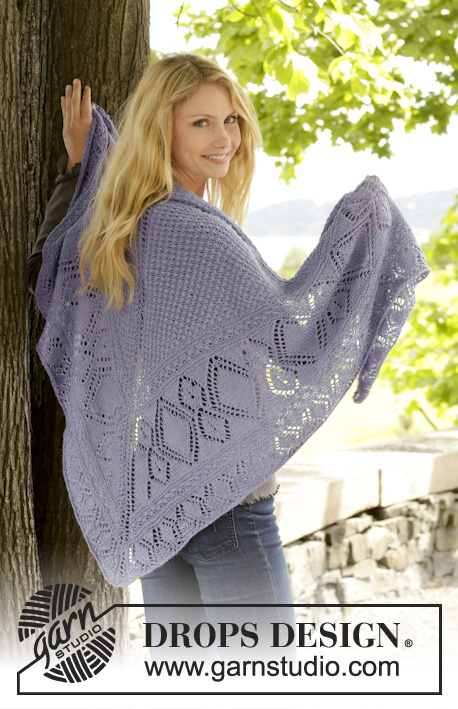
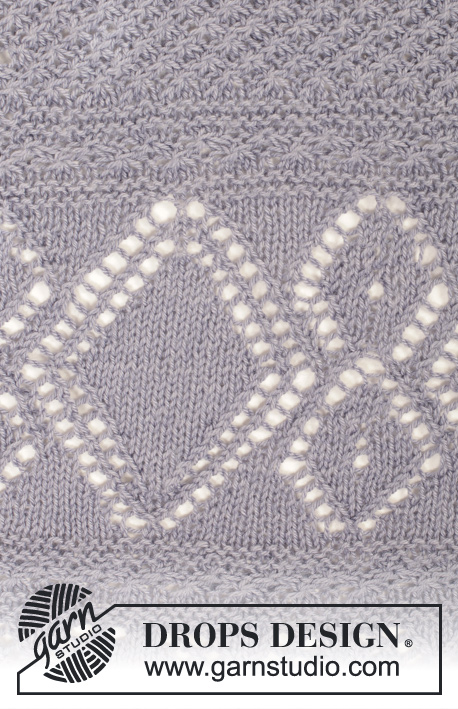
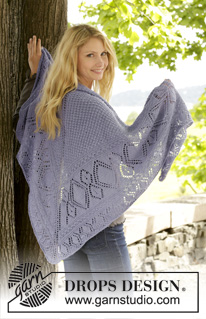
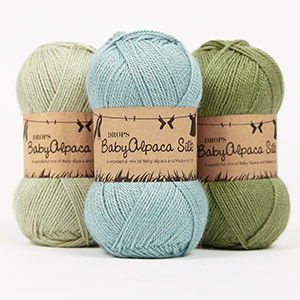
Scialle DROPS lavorato ai ferri a maglia legaccio con motivo traforato e a stella in "BabyAlpaca Silk".
DROPS 158-19 |
||||||||||||||||||||||||||||
|
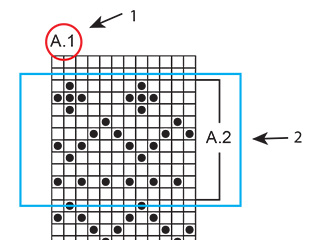
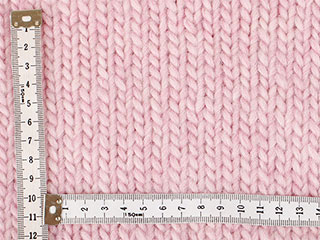
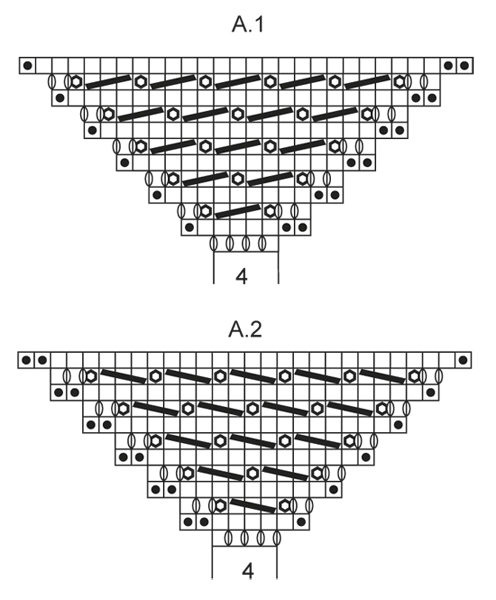
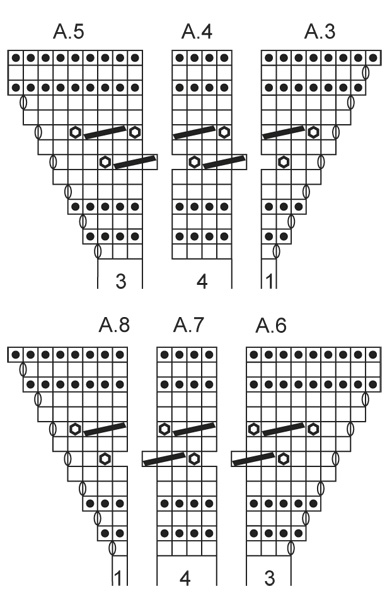
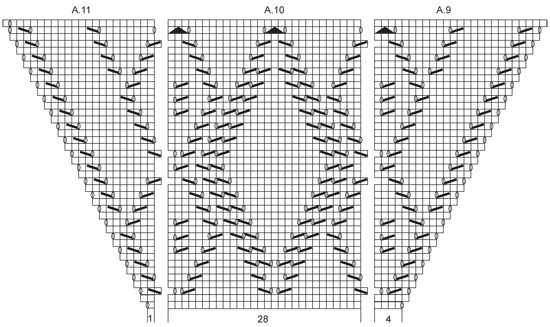
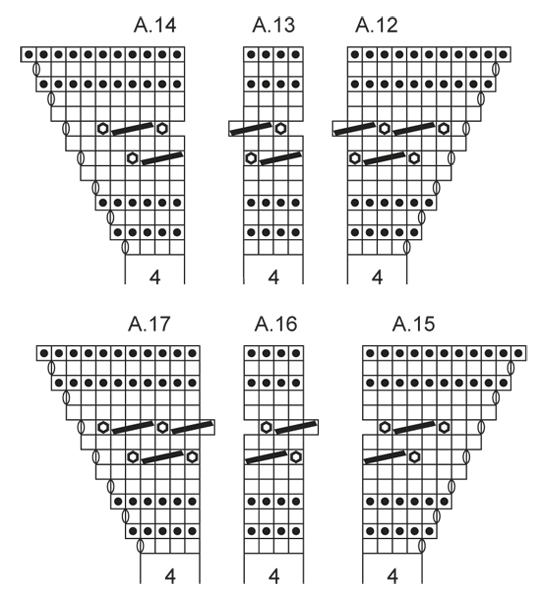
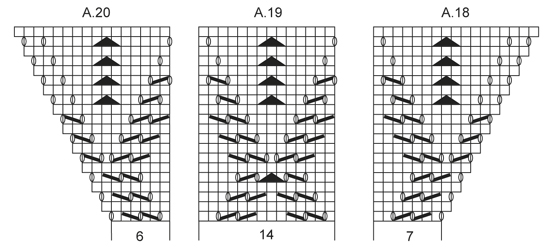
MOTIVO: Vedere i diagrammi A.1 e A.20. Il diagramma mostra il motivo visto dal diritto del lavoro. La 2 m di vivagno a ogni lato e la m centrale non sono nel diagramma. M LEGACCIO (avanti e indietro sui f): Lavorare tutti i f a dir. 1 “costa” a m legaccio = 2 f dir. MOTIVO A STELLA: Il motivo a stella è spiegato nel diagramma A.1 e A.2, lavorare in modo diverso sul lato destro e sinistro dello scialle. LATO DESTRO: 1 m rov, 3 m insieme a dir senza farle cadere dal f, 1 gettato. Lavorare ancora insieme a dir le stesse 3 m e farle cadere dal f = 1 stella. LATO SINISTRO: 1 m rov, 3 m insieme a dir ritorto senza farle cadere dal f. 1 gettato, lavorare ancora insieme a dir ritorto le stesse 3 m e farle cadere dal f = 1 stella. SUGGERIMENTO PER LE MISURE: Tutte le misurazioni devono essere fatte con l’indumento appeso perchè il motivo a stella si accorcerà. ---------------------------------------------------------- SCIALLE: Lavorato avanti e indietro sui f circolari per avere spazio per tutte le m. Lo scialle è lavorato dal centro dietro verso il basso. Avviare 9 m con i f circolari n° 3 mm con BabyAlpaca Silk. Poi lavorare come segue: 2 m di vivagno a M LEGACCIO – leggere la spiegazione sopra, 1 gettato, 2 m dir, 1 gettato, 1 m a m legaccio (= m centrale), 1 gettato, 2 m dir, 1 gettato, 2 m di vivagno a m legaccio. Lavorare a dir dal rovescio del lavoro, lavorare i gettati a dir per fare i buchi = 13 m. Lavorare 2 m di vivagno a ogni lato e 1 m centrale a m legaccio fino alla fine del lavoro, queste m non sono nel diagramma. FARE ATTENZIONE ALLA TENSIONE DEL LAVORO! Poi lavorare come segue secondo il diagramma A.1 e A.2 (1° f = diritto del lavoro): 2 m di vivagno a m legaccio, diagramma A.1 (= 4 m), 1 m a m legaccio (= m centrale), diagramma A.2 (= 4 m) e 2 m di vivagno a m legaccio. Aumentare 8 m nel diagramma su ogni f dal diritto del lavoro. Continuare a lavorare come mostrato nel diagramma. LEGGERE MOTIVO A STELLA e SUGGERIMENTO PER LE MISURAZIONI. Su ogni aumento c’è spazio per una ripetizione in più del motivo a stella a ogni lato della m centrale. Continuare a lavorare e aumentare come nel diagramma fino a quando ci sono 44 stelle a ogni lato della m centrale, il lavoro misura circa 38 cm misurati lungo la m centrale. Ora ci sono 357 m sul f in totale (178 m a ogni lato della m centrale). Finire dopo 1 f dal rovescio del lavoro, lavorare 1 f a dir dal diritto del lavoro e ALLO STESSO TEMPO distribuire 44 diminuzioni in modo uniforme a ogni lato della m centrale (diminuire lavorando insieme circa ogni 3° e 4° m, non diminuire sul bordo e sulla m centrale) = 269 m sul f (ci sono 134 m a ogni lato della m centrale). Lavorare 1 f rov dal rovescio del lavoro. Il lavoro misura circa 39 cm misurati lungo la m centrale. Ora lavorare come segue: 2 m di vivagno a m legaccio, A.3 (= 1 m), ripetere A.4 fino a quando rimangono 3 m prima della m centrale, A.5 (= 3 m), 1 m a m legaccio (= m centrale), A.6 (= 1 m), ripetere A.7 fino a quando rimangono 5 m, A.8 (= 3 m) e 2 m di vivagno a m legaccio. Lavorare i diagrammi 1 volta in verticale = 295 m. Poi lavorare come segue: 2 m di vivagno a m legaccio, A.9 (= 4 m), ripetere A.10 fino a quando rimangono 1 m prima della m centrale, A.11 (= 1 m), 1 m a m legaccio (= m centrale) A.9 (= 4 m), ripetere A.10 fino a quando rimangono 3 m, A.11 (= 1 m) e 2 m di vivagno a m legaccio. Lavorare i diagrammi 1 volta in verticale = 381 m. Poi lavorare come segue: 2 m di vivagno a m legaccio, A.12 (= 4 m), ripetere A.13 fino a quando rimangono 4 m prima della m centrale, A.14 (= 4 m), 1 m a m legaccio (= m centrale) A.15 (= 4 m), ripetere A.16 fino a quando rimangono 6 m, A.17 (= 4 m) e 2 m di vivagno a m legaccio. Lavorare i diagrammi 1 volta in verticale = 409 m. Lavorare 1 f dir dal diritto del lavoro e ALLO STESSO TEMPO distribuire 7 aumenti in modo uniforme con i gettati a ogni lato della m centrale (14 aumenti in totale) = 423 m (211 m a ogni lato della m centrale). Lavorare 1 f rov dal rovescio del lavoro, lavorare i gettati del f precedente a rov ritorto per evitare buchi. Alla fine lavorare come segue: 2 m di vivagno a m legaccio, A.18 (= 7 m), ripetere A.19 fino a quando rimangono 6 m prima della m centrale, A.20 (= 6 m), 1 m a m legaccio (= m centrale) A.18 (= 7 m), ripetere A.19 fino a quando rimangono 8 m, A.20 (= 6 m) e 2 m di vivagno a m legaccio. Lavorare i diagrammi 1 volta in verticale = 463 m. Intrecciare senza stringere. Il lavoro misura circa 68 cm misurati lungo la m centrale. MESSA IN FORMA: Mettere il lavoro in acqua tiepida fino a quando è bagnato. Eliminare delicatamente l’acqua – non strizzare. Poi avvolgere il lavoro in un asciugamano e far uscire altra acqua – il lavoro ora sarà solo umido. Posizionarlo su un tappeto o materasso – tirarlo delicatamente fino alle misure indicate in cima al modello. Lasciarlo asciugare. Ripetere il processo quando l’indumento è stato lavato. |
||||||||||||||||||||||||||||
Spiegazioni del diagramma |
||||||||||||||||||||||||||||
|
||||||||||||||||||||||||||||
 |
||||||||||||||||||||||||||||
 |
||||||||||||||||||||||||||||
 |
||||||||||||||||||||||||||||
 |
||||||||||||||||||||||||||||
 |
||||||||||||||||||||||||||||
Avete terminato questo modello?Allora taggate le vostre foto con #dropspattern #provenceshawl o inviatele alla #dropsfan gallery. Avete bisogno di aiuto con questo modello?Troverete 8 video tutorial, una sezione per i commenti/domande e molto altro guardando il modello su www.garnstudio.com © 1982-2026 DROPS Design A/S. Ci riserviamo tutti i diritti. Questo documento, compreso tutte le sue sotto-sezioni, è protetto dalle leggi sul copyright. Potete leggere quello che potete fare con i nostri modelli alla fine di ogni modello sul nostro sito. |
||||||||||||||||||||||||||||

Con oltre 40 anni di esperienza nel design di modelli di maglia e uncinetto, DROPS Design offre la più estesa collezione di modelli gratuiti su internet - tradotti in 17 lingue. Ad oggi vi possiamo fornire 333 cataloghi e 12525 modelli - 9799 dei quali sono tradotti in Italiano.
Ci stiamo impegnando molto per darvi il meglio che vi possiamo offrire in termini di maglia e uncinetto, ispirazioni e consigli così come filati di grande qualità ad un prezzo incredibile! Volete utilizzare i nostri modelli per qualcosa d'altro oltre al vostro uso personale? Potete leggere tutto ciò che è consentito nel testo sul Copyright in basso su tutte le pagine dei nostri modelli. Buon lavoro!
Lasciare un commento sul modello DROPS 158-19
Noi saremmo felici di ricevere i tuoi commenti e opinioni su questo modello!
Se vuoi fare una domanda, fai per favore attenzione a selezionare la categoria corretta nella casella qui sotto per velocizzare il processo di risposta. I campi richiesti sono indicati da *.